AI Solutions
AI Contact CenterAI-Enabled Contact Center Solution

AI Agent SolutionAutonomous agent for sales & support

AI Voice AgentConversational Voice AI Agent for Sales &
Support

Ticket Management System (SanTMS)AI-enabled Helpdesk and ticket management
solution
AI Noise Cancellation (SanClarit)Remove Background Noise in Real
Time

Calling Solutions
Call Center Solution (SanCCS)On-premises contact center
solution

Hosted Call Center Solution (SanCCS)Cloud-based contact center solution
with Zero Hardware Requirement

Click To Call (Dialer For CRM)CTI Integration with your internal & external
CRM

Office Telephony (SanIPPBX)Connect multiple-branch offices over the internet for voice
calls

Hosted IVR (EasyGoIVR)Cloud-based IVR Service for real-time call routing &
reporting
Industry Specific

Lead Management Software (VedaERP)Billing, accounting & ERP software

Immigration CRM (SanE-Visa)CRM to manage Leads, Status, College fee Structures, and
Invoices

Transport Management (SanTrans)Transport Management System for transportation
businesses

Real-Estate CRM (Mera Estate)Complete property management system for brokers and real
estate agencies

Order Management (SanORDO)Automates and streamlines order processing for D2C
businesses

WhatsApp Solution
TeamInspectorWhatsApp Chat Monitoring Tool for
Businesses

WhatsApp Business ToolWhatsApp Business Calling Solution with
Meta

WhatsApp Business CallingWhatsApp Chatbot Integration for
Industries

Table of Contents
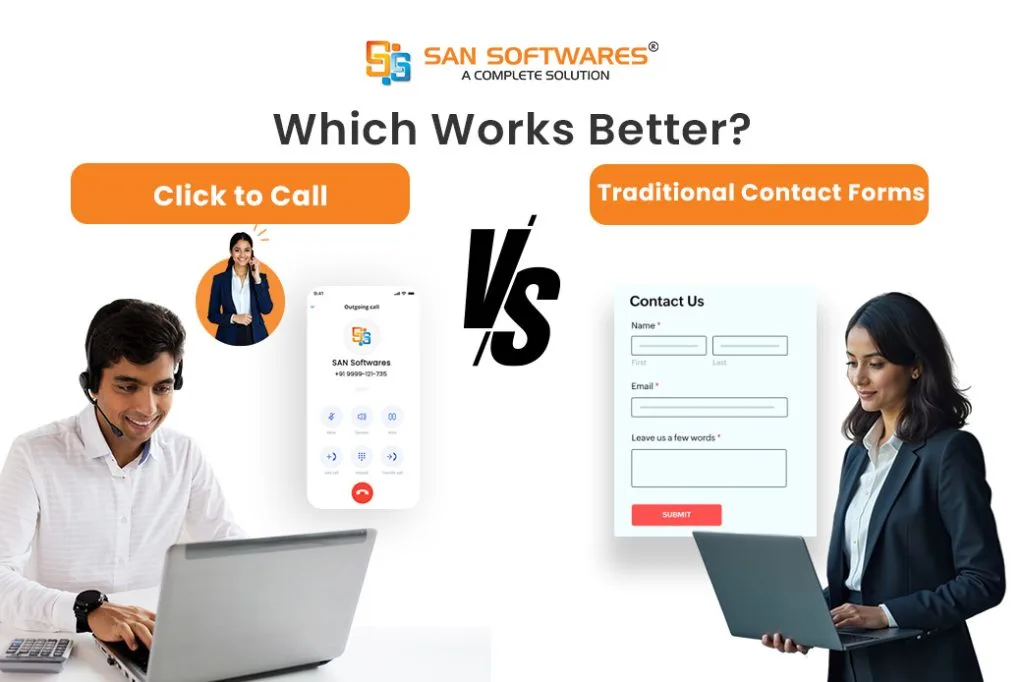
All business depends on smooth communication for immediate and effective customer engagement. When a potential lead shows interest, the window for conversion is brief. This is where the only choice between Click to Contact and a Traditional contact form becomes crucial.
While both methods offer ways to capture leads, only one provides the quick engagement that outbound strategies demand. In this blog, we break down which works better, based on real performance data, usability, and business impact.
Click to Contact can be integrated into CRM, a website, or a browser. It allows agents to click on a customer and start making a call immediately. It is commonly referred to as click to call, click to dial, or click to talk. This application was created for agents to make outbound calls to leads that are currently engaged and have shown interest. It minimizes the time delay between intent and contact, which will dramatically increase the chances of converting a lead.
Traditional contact forms require all visitors to input their information, which includes their name, phone number, email, and message. After submitting the form, it is sent to a group of people who will eventually respond, either by phone or email, at their convenience.
Contact forms are used everywhere and are widely accepted; however, they are slow and passive, especially when you are competing for leads and need to make your conversion fast.
| Features | Click to Contact | Traditional Contact Forms |
|---|---|---|
| Lead Engagement | Instant call from an agent | Delayed (Manual follow-up) |
| Effort Required | One-click Call | Multiple from fields |
| Lead Quality | High (real-time intent) | Varies (Intent unclear) |
| Conversion Rate | Higher | Lower |
| Integration | CRM, Auto dialers, call routing | Email or basic CRMs |
| Ideal for | Fast outbound calling | Capturing passive leads |
A Harvard Business Review study found that responding to leads within 60 minutes makes businesses seven times more likely to qualify them. With Click to Call, your team can connect within seconds. Contact forms often suffer from delays of hours or even days, resulting in cold leads.
Data from Incova indicates that businesses using voice-based lead capture tools like Click to Call report conversion of 30-50%, compared to just 2-5% with a contact form. When users ask for a call, it’s an open invitation to pitch-making, a prime opportunity for outbound agents.
Forms often ask for multiple details, which leads many visitors to abandon them. Many researchers found that 53% of users leave a website without filling out forms if the process is too long. Click to Contact eliminates the friction; just one click, and a callback is initiated.
An outbound call allows agents to qualify leads on the spot by asking questions, addressing concerns, and booking demos or follow-ups. All within the same interaction. Form can’t provide this level of immediacy or personalization.
While forms are useful for basic and general inquiries, they’re not designed for fast-moving outbound strategies. They:
For all businesses that focus on real-time interaction, relying solely on forms limits potential.
Every second counts. With a single click, your system can initiate an outbound call, keeping engagement levels high.

Users who click to request a call are showing strong intent. Outbound teams can prioritize these calls over colder lists.
Every second counts. With a single click, your system can initiate an outbound call, keeping engagement levels high.
No need to go through low-quality form submissions. With Click to Dial, agents focus on users who genuinely want to speak, increasing call efficiency and conversion rates.
As you have gone through the entire blog, we have explained how the fast-paced business environment is evolving. Click to Contact has already eliminated delay by allowing outbound agents to instantly connect with interested customers, resulting in fast response times, higher conversions, and more meaningful interactions. Unlike traditional contact forms that rely on delayed follow-ups,

Click to Dial ensures that intent is captured and acted upon in real time. For businesses aiming to improve outbound efficiency, prioritize high-quality leads, and reduce response gaps, integrating a click-to-call solution is no longer just an option. It’s essential for staying competitive and closing deals when interest is at its peak.

Discover how SanCCS-Click-to-Call enhances real-time customer conversations!
For more information on Click-to-Call solutions and how they improve lead conversion.
Book a FREE Demo Today!
A Click-to-Call dialer is a software feature that automatically detects phone numbers and makes them clickable, allowing users to start calls with a single click.
The dialer detects phone numbers within a digital interface (e.g., website, CRM) and integrates with a communication system to initiate the call when a user clicks the number.
It saves time for agents by eliminating the need for manual dialing, improves productivity, and helps with call tracking and recording.
Sentiment Analysis
Quality Auditing
CRM Integration
© 2026 SAN Softwares Pvt Ltd | All Right Reserved
Enter your details and captcha to start the call
SanClarity
SanClarity removes unwanted environmental noise so your agents can communicate clearly, stay focused, and sound professional to customers.