Contact Center Sentiment Analysis for Tele Callers & Customers

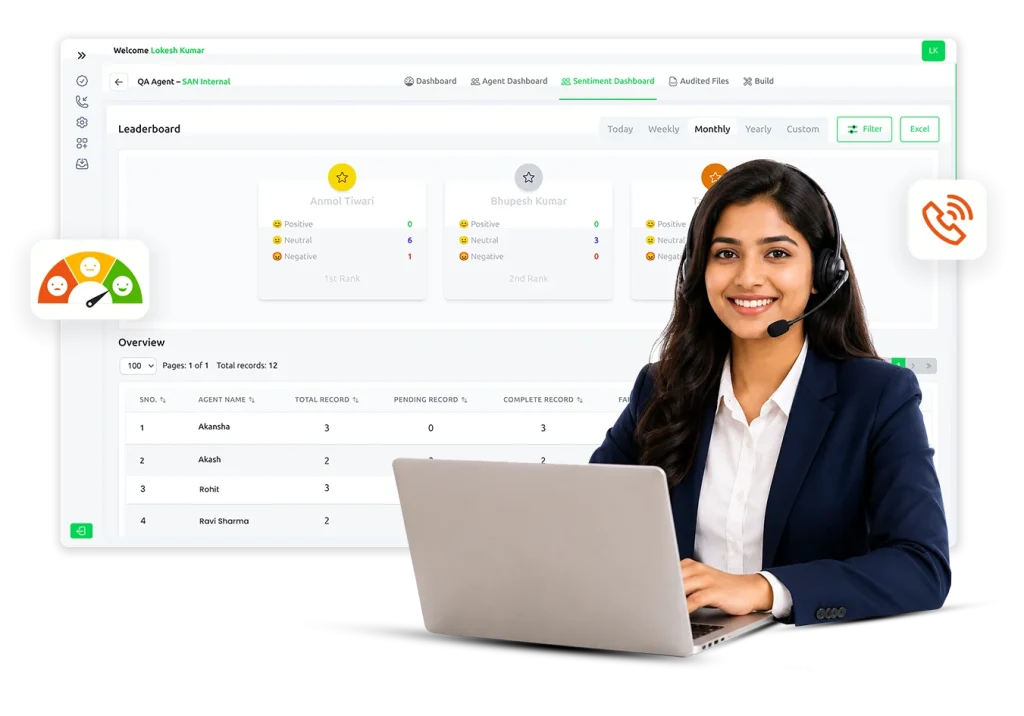
Capture every customer's emotion into actionable insight with Contact Center Sentiment Analysis. SAN Softwares’ AI Sentiment Analysis deliver real-time sentiment detection for both customer and tele callers. It helps team supervisor to priorities high risk conversations, coach agent actively and boost customer experience.


Contact Center Sentimental Analysis

Trusted By More Than 2200+ Clients

Contact Center Sentimental Analysis Dashboard

What is Contact Center Sentiment Analysis?

Contact Center Sentimental Analysis is the process of using AI and natural language processing to automatically understand customer and agents' opinions, emotions, and attitudes during phone calls.

It analyzes tone, word choice, and speech patterns, then labels each interaction as positive, negative, or neutral. This provides insights into customer satisfaction, highlights emerging issues, and improves call center agent performance.

What Are the Benefits of Sentiment Analysis?

Contact Center for sentiment analysis to provide useful operational signals. Here are benefits you should know:

Better Quality Monitoring

Better Quality Monitoring

AI Sentiment Analysis can evaluate larger volume of agent & customer interactions than manually QA sampling.

Earlier Identification of Expression

Earlier Identification of Expression

Real-time Sentiment Analysis measures early identification of expression by agent and customer during the call.

Focused QA & Coaching

Focused QA & Coaching

Sentimental analysis helps managers prioritize interactions that require proper agent coaching.

Understanding Customers’ Context

Understanding Customers’ Context

Combining sentiment with topics and call reasons can reveal the issues causing customer emotions.

Telephony Icon

Escalation Risk Detection

Negative sentiment can help identify support cases that may require early intervention.

Post Call Surveys

Post Call Surveys

Sentiment Analysis provides interaction level feedback even when customers do not complete a CSAT Survey.

How Does Sentiment Analysis Works?

It uses speech recognition, natural language processing, and machine learning to identify the tone of customer and agent conversation. Let's understand how sentiment analysis works:

Captures the Interaction Icon
Captures the Interaction

The system collects call recording, live audio, chat messages, emails, or transcripts.

Converts Speech into Text Icon
Converts Speech into Text

For voice calls, speech recognition technology converts the conversation into a transcript for analysis.

Separates Speaker Icon
Separates Speaker

The system identifies which words were spoken by the agent or customers.

Analyzes Language Icon
Analyzes Language

NLP examines which words, phrases, contexts, and communication patterns. It analyzes customer emotional indicators such as complaints, negative statements, appreciation, or requests for escalation.

Generates Alerts or Scores Icon
Generates Alerts or Scores

If the customer becomes highly frustrated, or excited, or the interaction shows any risk, the system gets notification, flag the calls for Quality Assurance, or recommend escalation.

MIS Report Icon
Create Reports and Insights

Sentiment Analysis Report can be combined with call reason, resolution status, CSAT, transfer rate, and complaints to identify recurring customer and agent interaction patterns.

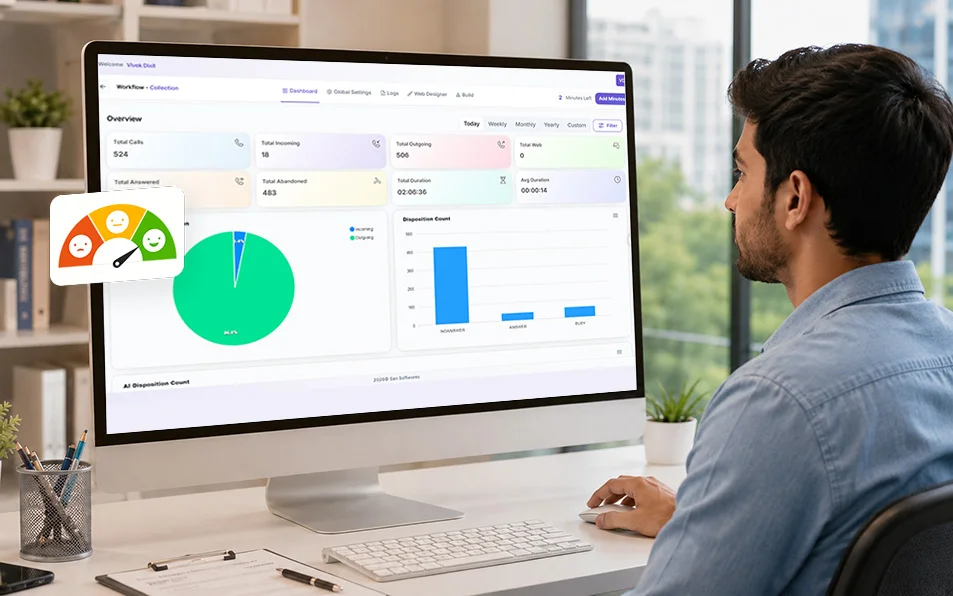
Sentiment Analysis Panel

Use Cases of Contact Center Sentiment Analysis

Real-Time Monitoring

Real-Time Monitoring and Intervention

  • Detects customer frustration, confusion, anger, or dissatisfaction during call or chat
  • Monitors Agents’ tone, response quality, and ability to handle customer queries.
  • Alert team when customer sentiment becomes highly negative
  • Enables AI Voice Agent to adjust its response, slow down, or use more empathetic language.

Quality Assurance and Agent Training

  • Flags call where customer sentiment declines during the interaction.
  • Identifies how an agent’s response affects customer sentiment.
  • Helps quality teams prioritize calls for detailed review.
  • Highlights of coaching needs related to empathy, active listening, patience, and conflict handling.
  • Provides real conversation examples for agent training and performance improvement.
  • Compares customer and agent sentiment to assess the overall interaction quality.
Quality Assurance and Agent Training
Proactive Strategy

Business Intelligence and Proactive Strategy

  • Identify products, services, policies, or processes that cause customer frustration.
  • Reveals recurring issues across calls, teams, locations, or customer segments.
  • Helps identify interactions that may require escalation or follow-up.
  • Supports improvements in scripts, workflows, call routing, and service processes.
  • Combines sentiment data with CSAT, resolution rate, repeat calls, transfers, and complaints.
  • Helps businesses address recurring problems before they lead to more complaints or customer loss.

Frequently Asked Questions

Contact center sentiment analysis is the automated analysis of customer and agent conversations to identify emotional tone, attitude, and changes in sentiment. It can classify interactions as positive, neutral, or negative and may detect signals such as frustration, confusion, satisfaction, or anger.

For voice calls, the system generally converts speech into text and analyzes the words, phrases, and conversation context. SAN Softwares Contact Center Sentiment Analysis also analyze vocal characteristics such as pace, pitch, volume, interruptions, and pauses. The results can be used to monitor customer sentiment, agent sentiment, or both.

Yes, SanAI- Contact Center Sentiment Analysis detects both customer and agent’s emotions. Speaker separation allows the conversation to be analyzed by participants, so the system can compare the customer’s emotional state with the agent’s tone, language, and response. This can help identify whether the interaction is improving or not.

It can flag interactions with strongly negative sentiment, declining sentiment, or unusual customer–agent sentiment patterns. Your teams can review those interactions in detail instead of relying only on random auditing samples. The sentiment result should support QA review, not replace human judgment.

Yes. In a live interaction, sentiment can be updated as new speech or messages are processed. A supervisor may receive an alert when customer sentiment becomes highly negative or when the conversation shows signs of deterioration. The practical value depends on model accuracy and the organization’s response process.

A dashboard can show sentiment by customer, agent, team, channel, call reason, product, location, and time. Useful views include sentiment trends, calls requiring review, customer, agent sentiment comparison, escalation, key indicators, key suggestions to improve, agent score and links to the relevant transcript or recording.

Verify to Start Call

Enter your details and captcha to start the call

Call Us WhatsApp Website Chatbot
AI Chatbot

Loading…