
Cloud-based IVR System deployment is now dominant (over 75% in 2025), offering easier integration and flexibility with any system.
Why this shift? Because customers are tired. Due to long wait times, unresponsive or disconnected calls, and multiple call redirects when calling any business. However, these inefficiencies have created a negative image for call centers and the companies that manage them.
According to the report, customers are constantly demanding 24/7 support availability, faster responses, self-service options, a smooth first-contact experience, reduced dependence on human agents, and consistency and reliability.
Therefore, businesses are rapidly moving towards Cloud IVR solutions. The report highlights a 48% growth in cloud IVR system adoption between 2022 and 2025 in the mid-Pacific region. It is seen that India and Southeast Asia added more than 118,000 new cloud IVR System installations in 2025 alone.
If your business is still behind in adopting hosted IVR Software, then this blog is for you. Let's explore how an IVR system can benefit you and how to set it up.
Key Takeaway
A cloud-based IVR, or hosted IVR solution, is an innovative, automated calling solution that helps businesses handle customer calls without relying heavily on human agents. Instead of using complex hardware, everything runs on the cloud, making it easy to set up, manage, and scale. Customers can choose options through voice menus, get quick answers, and reach the correct department faster, saving time for both agents and callers.
In 2025, hosted IVR has become the top choice for businesses because it offers high flexibility, seamless integration with CRM or telephony systems, and 24/7 availability. It also reduces call wait times, dropped calls, and repeated transfer, which improves customer satisfaction.
With demand rising for self-service and instant support, more companies are switching to cloud IVR System to deliver a better calling experience. If your business wants fast responses, improved productivity, and reliable customer service, a hosted IVR System is one of the best solutions to start with.
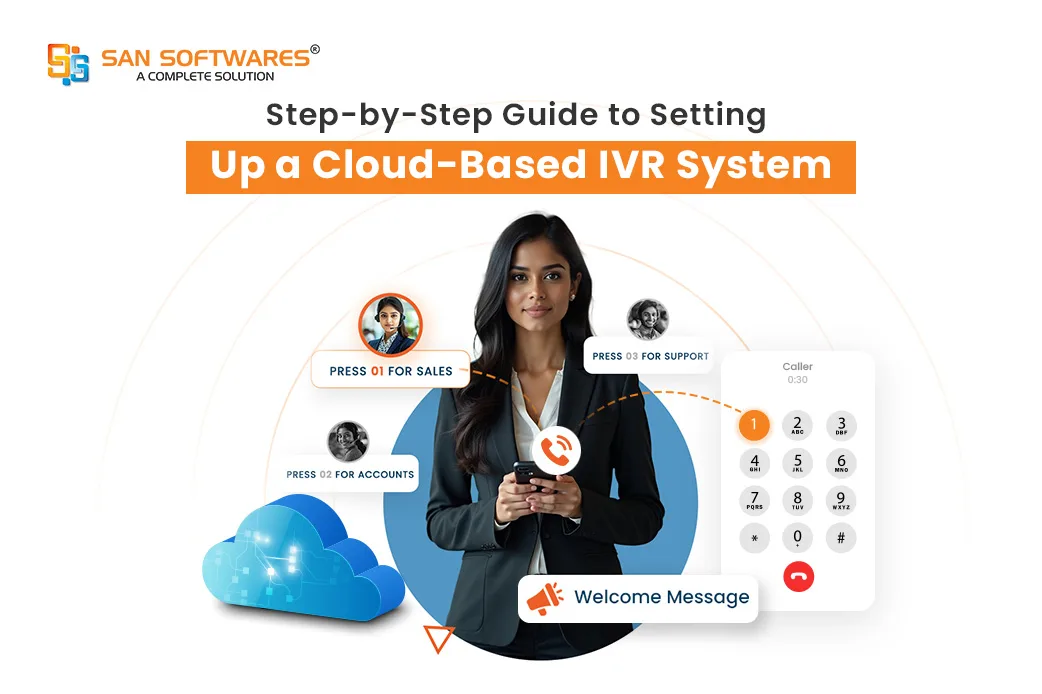
An Interactive Voice Response System guides callers through a set of automated voice menus. When a customer calls your business number, the IVR answers the call and plays a pre-recorded greeting, such as “press 1 for sales, press 2 for support.” Or if it is AI-enabled IVR or an Agentic bot, the customer will directly ask their query without even dialing a number.
Here’s how it works:
Setting up an IVR (Interactive Voice Response) system is simple when done step by step. First, choose a cloud-based IVR provider that fits your business needs. Cloud IVR systems are easy to deploy, require no hardware, and can be managed from an online dashboard.
Select a reliable cloud-based IVR software that supports easy setup, scalability, and integration with CRM or call center tools.
Analyze common customer queries such as sales, support, billing, or general inquiries to design an effective IVR structure.
Create a simple call menu like Press 1 for Sales, Press 2 for Support. Keep options limited to avoid confusing callers.
Log in to the IVR dashboard and set up the main menu with keypress or voice-based options.
Add a welcome greeting and menu instructions using recorded audio or text-to-speech features.
Assign each option to the correct agent, department, queue, voicemail, or self-service action.
Define working hours, after-hours routing, holiday rules, and fallback options for missed calls.
Enable caller ID pop-ups, call logging, and ticket creation for faster resolution.
Make test calls to ensure prompts, routing, and integrations work correctly.
Activate the IVR, monitor call reports, and optimize the flow based on customer behavior and feedback.
A Cloud-Based IVR System is no longer a luxury, it’s a necessity for businesses that want to deliver fast, reliable, and customer-friendly support. From reducing call wait times to enabling self-service and 24/7 availability, IVR solutions help you meet modern customer expectations while improving team efficiency.
If your business is still relying on outdated call-handling methods, now is the right time to upgrade. A hosted IVR system can help you streamline communication, enhance customer experience, and scale effortlessly as your business grows.
Ready to modernize your call handling?
Explore a smart, cloud-based IVR solution today and transform every customer call into a smooth and satisfying experience.
A Cloud-Based IVR System is an automated call-handling solution that runs on the cloud. It allows customers to interact with voice menus or speak their queries and get routed to the right department without human intervention.
Unlike traditional IVR, cloud IVR does not require physical hardware. It is easier to set up, scalable, cost-effective, and integrates seamlessly with CRM and call center software.
Yes. Cloud IVR systems are ideal for small and medium businesses because they are affordable, easy to manage, and can scale as the business grows.
Yes. An IVR system works round the clock, allowing customers to access self-service options or leave requests even outside business hours.
Absolutely. Most cloud IVR systems integrate with CRM and helpdesk tools to enable caller identification, call logging, and faster issue resolution.
Yes. Cloud IVR providers offer high uptime, data security, call recording, and backup systems to ensure consistent and reliable performance.
A basic IVR system can be set up within a few hours, while advanced IVR with integrations may take a few days.
Yes. IVR routes calls instantly to the right department or self-service option, significantly reducing wait times and call transfers.




SAN Softwares is a company dedicated to providing complete software solutions to Corporate and end-user customers.

SAN Softwares is a company dedicated to providing complete software solutions to Corporate and end-user customers.
© 2026 SAN Softwares Pvt Ltd | All Right Reserved
Enter your details and captcha to start the call